About VEAM 2025
Theme
“Sustainable Development and Economic Transformation in the Digital Age”
Sustainable Development and Economic Transformation in the Digital Age
Videos
1 recordings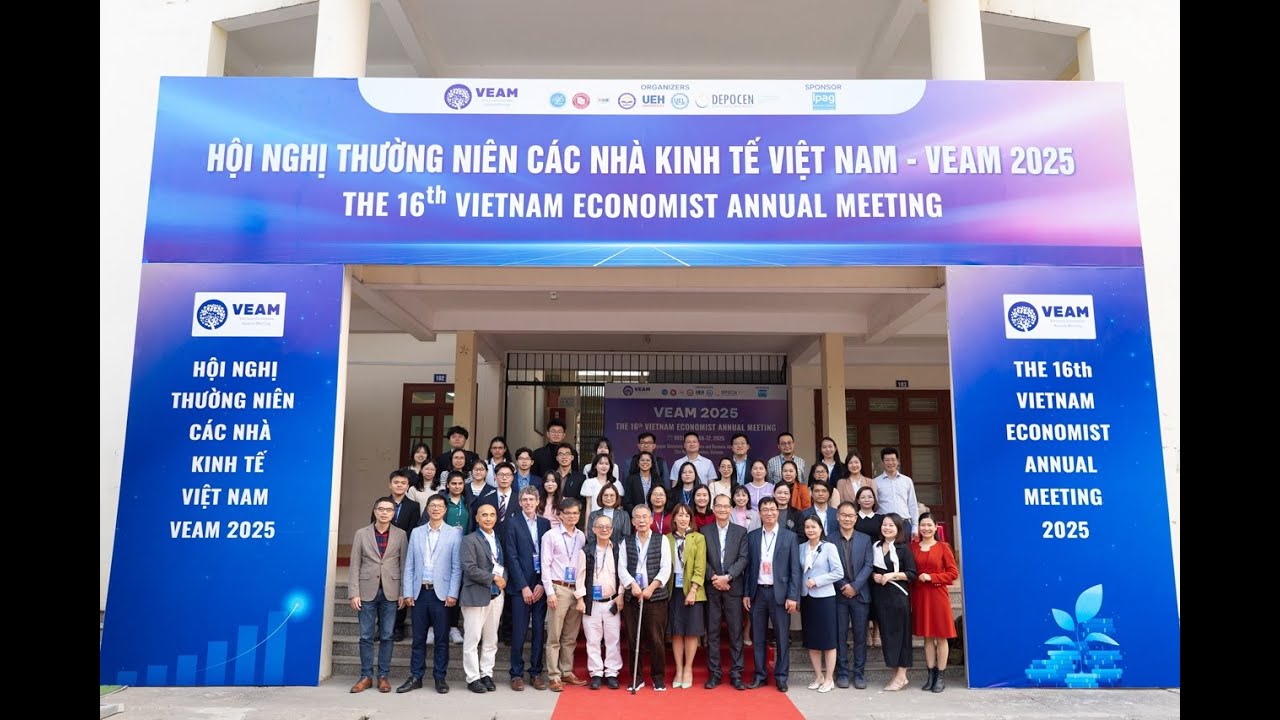
Conference Papers
85 papersSelected papers presented at VEAM 2025. Click any paper card or the PDF button to access the full text.
Real interest rates and age dependency: Evidence from the U.S. and Emerging Markets under global spillovers
Viet Duc Mai (Academy of Policy and Development)
The persistent decline in global real interest rates has generated debate over the structural forces driving this trend, with demographic aging increasingly viewed as a key factor. This paper investigates the impact of age dependency on real interest rates using a balanced panel dataset from World Bank for the United States and 15 emerging market economies (BRICS and CIVETS) from 2000 to 2024. A fixed-effects regression is first employed with real interest rate as the dependent variable and age dependency as the main explanatory variable, controlling for imports, exports, inflation, and unemployment. The baseline results suggest a positive association between aging and real interest rates, while inflation demonstrates a robust negative effect. To account for the possibility of global spillovers and convergence, Pesaran’s CD test is applied and confirms significant cross-sectional dependence, consistent with existing evidence on U.S. monetary spillovers to emerging markets. Accordingly, a two-way fixed effects specification with clustered standard errors is estimated. Under this more robust framework, the effect of age dependency becomes statistically insignificant, while inflation remains a consistent driver of declining real interest rates. These findings highlight that while demographic aging may matter in closed-economy contexts, global financial integration and spillovers dominate long-term interest rate dynamics in emerging markets. Future research should shift attention from demographic structure toward global financial integration, capital flows, and monetary spillovers as key determinants of long-term interest rates.
The Uneven Impact of Economic Policy Uncertainty on Stock Prices: A Study of ASEAN-5 Nations
Linh Thi Thuy Tran, Le Van Hung (Thai Nguyen University of Economics and Business Administration)
The research paper analyzed the potential for asymmetric causality between U.S. policy uncertainty and the stock markets of five ASEAN nations: Indonesia, Thailand, Malaysia, the Philippines, and Vietnam. The study applied a new method called asymmetric Granger-causality, developed by Hatemi-J, to data spanning from 1989 to 2015. The findings reveal that these countries do not react uniformly to economic shocks, and the idea that stock prices will always be affected is not consistently supported. The results specifically show that positive shocks in U.S. political uncertainty have a unidirectional causal effect on Vietnamese stock prices. In contrast, the hypothesis that political uncertainty leads to changes in stock prices cannot be rejected for the other four countries. The study concludes that investment firms, investors, and policymakers need to create investment strategies and policies to navigate structural changes and economic policy uncertainty.
Determinants of Credit Risk Management Practices: Empirical Links to Performance in Vietnam’s Commercial Banking Sector
My Dung Thi Dang, Nguyen Duc Hong Ngoc, Nguyen Ngoc Tra, Vu Thai Nam Anh, Nguyen Hoang Nguyet Anh, Nguyen Le Lan Vy (Foreign Trade University, Ho Chi Minh City)
Following the global financial crisis, credit risk management has become a key priority for international regulators, highlighting the contrast between institutions with robust frameworks and those lacking them. Banks with effective risk management systems have shown greater stability during economic downturns, yet many organizations still struggle with fragmented approaches, hindering their risk management capabilities. This study investigates the factors influencing credit risk management and their effects on the performance of commercial banks in Vietnam, while also examining how credit risk management mediates bank outcomes. Analyzing data from 25 Vietnamese commercial banks and macroeconomic indicators from 2017 to 2023, the study uses a generalized linear model (GLM) to pinpoint factors affecting credit risk, focusing on non-performing loans (NPLs). The research findings indicate that Loan Loss Provisions (LLP) and bank leverage increase NPLs, while Return on Equity (ROE) is negatively associated with NPLs. Economic growth (GDPgr) helps reduce NPL ratios, but macroeconomic factors like exchange rates, lending interest rates, and inflation increase NPL pressure. These results emphasize the critical role of credit risk management practices and the influence of both internal and external factors on managing credit risk in the banking industry.
Designing Self-Evolving, Ai-Governed Circular Economy Ecosystems: Toward Autonomous Esg Value Chains In Emerging Markets
Bach The Truong, Phuong Nguyen Ha, Trang Duong Thu, and Vy Dang Nga (Diplomatic Academy of Vietnam, Hanoi; Foreign Trade University, Hanoi)
The Effects of Industrial Agglomeration on Manufacturing firms: Evidence from Vietnam
Huynh Ngoc Chuong, Tran Thi Quynh Nhu (University of Economics and Law, Ho Chi Minh City)
This study aims to examine the impact of economic agglomeration on the performance of manufacturing enterprises in Vietnam. The authors focus on spillover effects such as urbanization, localization, and competition. Utilizing a panel data of 86,420 firms continuously operating between 2012 and 2020, the results reveal that agglomeration effects are significantly reinforced through interaction effects, specifically, between urbanization and competition, and between urbanization and localization. In contrast, the individual effects of urbanization, competition, and competition tend to negatively influence firm performance. These findings underscore the need for policy interventions that promote integrated infrastructure development, strengthen enterprise competitiveness, and expand high-potential agglomeration zones.
Showing 5 of 85 papers